“I manage”

Designing Real-Time Clinical Documentation in Emergency Care Handover

Thesis Project | In collaboration with Systems Biology Institute (SBI) Japan

Research Project | Medical context | Non-Diagnostic AI
Overview of the project

The client brief asked us as researchers to explore and research potential areas for non-diagnostic AI to enter clinical spaces in Indian hospitals. The project researched the Emergency Room to Inpatient Handover workflow that is performed by Nurses and looked at the way communication and information exchange is affected by the environment, the governance and most importantly, the people.

Duration: 4 months

Role: Solo researcher and designer

Collaborations: Systems Biology Institute (SBI), ER Nurses, IPD Nurses, ER Doctors

Client Profile and Ask

Non-profit private research institution focused on systems biology research and its applications in medicine and sustainability, working with hospitals, pharmaceutical organizations, and research institutions.
DISHA Aide is an AI-enabled hospital support initiative that explores how technology can assist clinicians, nurses, caregivers, and hospital staff in clinical processes.

“Research and prototype AI-enabled clinical support systems that enhance efficiency, safety, and continuity of care across varied hospital contexts into AI-enabled tools, workflows, and narratives.”

03 // Research Focus

Handovers and why do they matter?

What are handovers?

Transfer of professional responsibility and accountability for some or all aspects of care for a patient, or group of patients, to another person / family / legal guardian or professional group on a temporary or permanent basis

What are they important?

Reduce error and inefficiences

Poor handoffs can cause delays, inappropriate care, longer hospital stays, and confusion.

Ensure Accountability

Ensuring everyone knows who is responsible for decisions and tasks at any moment. Proper documented handovers, either through paperwork or digitally place responsibility on the actors.

Continued Care

To effectively manage and plan patient care without interruptions.

Timely communication of critical clinical information is essential for delivering the right care, and failure in handover is a major source of preventable patient harm.

What are Interdepartmental handovers?

Handovers that take place across departments and departmental clinicians in the same hospital.

These come with complete context shifts and clinician changes in the patient treatment and are a crucial point in patient care consistency.

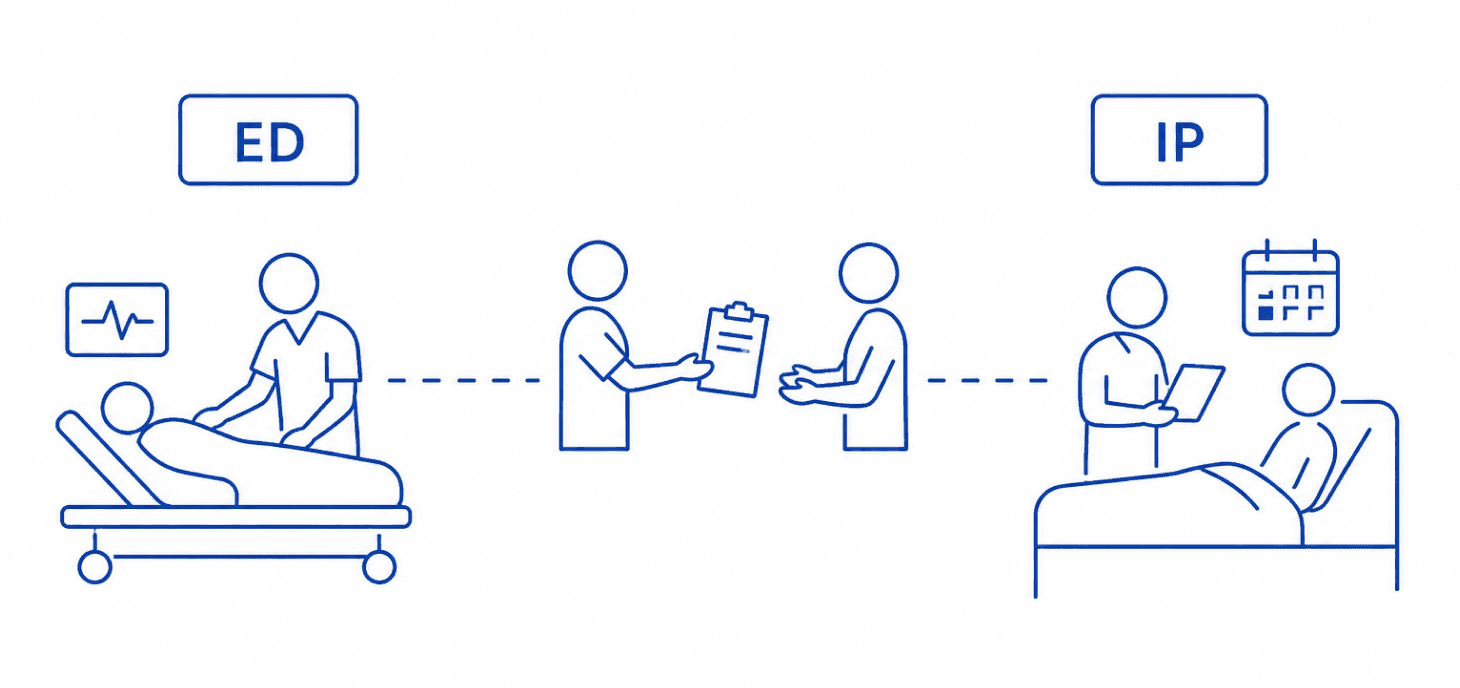
ED (emergency department) to IPD (inpatient department) patient handovers

“In ER, we handle everything, and everything can go wrong here"

This quote by a Doctor at a Cancer hospital in Bengaluru, made me realise that the way the Emergency Dept. functions is hard to standardize in terms of schedule. They have to constantly adapt and think on their feet to ensure that patient care is delivered consistently and correctly from the point the patient comes to the ED till they are discharged from the IPD.

Why this research focus?

Emergency Department and the Inpatient Ward have fundamentally different ways of approaching patient care. Despite this, their primary goal is always to ensure Optimal Patient Care.

This transition between departments, and as a result, the transfer of patient information and responsibility has multiple factors that affect it.

Focusing on handovers also places AI in a supportive socio-technical role, augmenting clinicians’ communication and continuity of care while avoiding many of the regulatory and ethical complexities associated with diagnostic AI.

High Intensity and Pressure environment
Strictly time bound actions

Complete context shifts

Background Research
Nuances of a Handover

Handovers act as the bridge between departmental transfers. They are the backbone to ensure that a patient’s care plan is carried out correctly.

In a handover, the two clinicians, receiver and sender, communicate about the patient history, background, diagnosis and possible treatment. This is a quick 5-10 min activity.

Handovers are done during shift changes, clinician changes and departmental changes.

Existing Handover Protocols

ISBAR: Introduction | Situation | Background | Assessment | Recommendation

I-PASS: Illness severity | Patient Summary | Action list | Situation Awareness | Synthesis by receiver

Scope for AI intervention in the Current Market

Documentation aides | Organizational help | Departmental co-ordination

Market competitors: Suki.ai, Siemens Xcelerator, Kezava Health, Glass Health
Diverse Documentation systems

Paperwork | Digital | Hybrid

These systems determine the workflows of the nurses and the doctors as they have to figure out clinical work around the system of documentation. Documentation acts as the basis of a handover, hence it is important to have correct documentation on hand.

Challenges in Interdepartmental Co-ordination

Ineffective inter-departmental interactions |Ineffective information handoffs | Ineffective information technology

03 // Research Question

How is patient information reconstructed during interdepartmental clinical handovers, and how can non-diagnostic AI systems be designed to support socio-technical alignment and information continuity?

04 // Field Work

Workflow researched

If you as a patient had to go through the workflow, this is how it would look like. The project explored the clinician side of this workflow, with a focus on the Nurses in the ED and IPD and their clinical and administrative tasks.

Synthesis of field research across sites

Field work site explorations

Disclaimer !

The Emergency Room being a sensitive space, has strict privacy laws enforced across hospitals.

Photography was prohibited across hospitals and select frames are displayed with approval.
Cytecare Hospital

3 days at Cytecare Hospital.


Day 1: Tour of the Hospital to understand larger organizational functioning


Day 2 & 3: ED specific visits for semi structured Interviews with nurses and ED doctors along with observational activities.

Super specialty Hospital

Small sized ED

Hybrid documentation system

Objective of the visit

The initial few visits in an hospital environment were to understand how theory read works on field in reality. The aim was to speak to nurses about their handover practices and general workdays to build better questions and research plans for the planned research visits. The interviews conducted were exploratory and good bases to find threads of specific exploration.

Spoken to:

4 nurses

1 doctor

Snippets from interviews

In ER, we stabilize the patient first and then diagnose

In ER, we handle everything, and everything can go wrong here

IP, they just want all orders that are ready to be given

What I learnt from the conversations

Double documentation systems= double and unequal work

The system requires the nurses especially to have documentation of the treatment in both the paperwork and digital systems. This results in double work and more of “pajama hours” being put in. Plus the irrelevant or lesser used system, i.e the digital system is approached in a lax way compared to the paperwork documentation.

The ED and Ward have varied priorities in patient care.

The ED aims to stabilize the patient, the IP Ward aims to focus on the continuity of care. In the ED, Documentation will happen post treatment and stabilization as patient care is the priority. In the IP, they want streamlined communication, they would like a treatment plan ready when a patient is handover over.

Informal calls fuel handovers more than updating the system for Doctors

The IP Doctors are required to fill a Patient Assessment within one hour of receiving the patient. However, often they just skim through the notes and write up something. To ensure that the patient information is communicated, the ED Doctor calls the IP Doctor and relays the prioritized info.

Hierarchy affects and plays a huge role in the way patient diagnosis and treatment is approached in the ER.

The ED is required to call multiple specialists in a trauma case for consulting on aspects of treatment. The organizational and social hierarchies bleed into these interactions affecting the way patient treatment progresses in the Emergency Department.

Cytecare Hospital

SRM Hospital

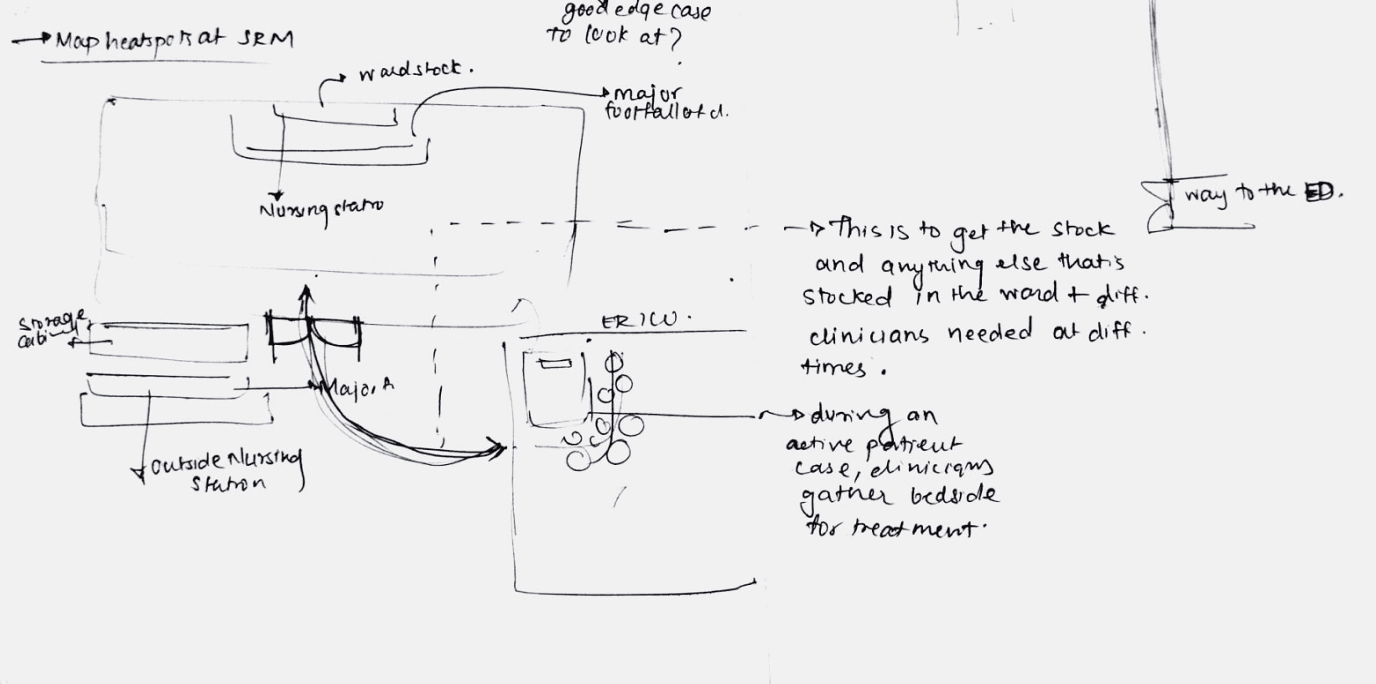
5 days at SRM Global Hospital.


Day 1, 2 &3 : Emergency Department observational research + interviews


Day 2 & 3: Inpatient Department interviews with Nurses

Multi specialty Hospital

Large sized ED

Paperwork documentation system

Objective of the visit

Get an indepth understanding of the functioning of the Emergency Department for handovers to IPD.

More focused research was done as this was a beta testing site for the client’s product. This allowed insights into how clinicians already perceived in their workspace and how it helped/hindered their work.

Spoken to:

10 nurses

1 doctor

Snippets from interviews

“document only will speak in the future”

“Everyone is responsible for everything in a Healthcare system. We are dependent on each other.”

What I learnt from field interactions and observations

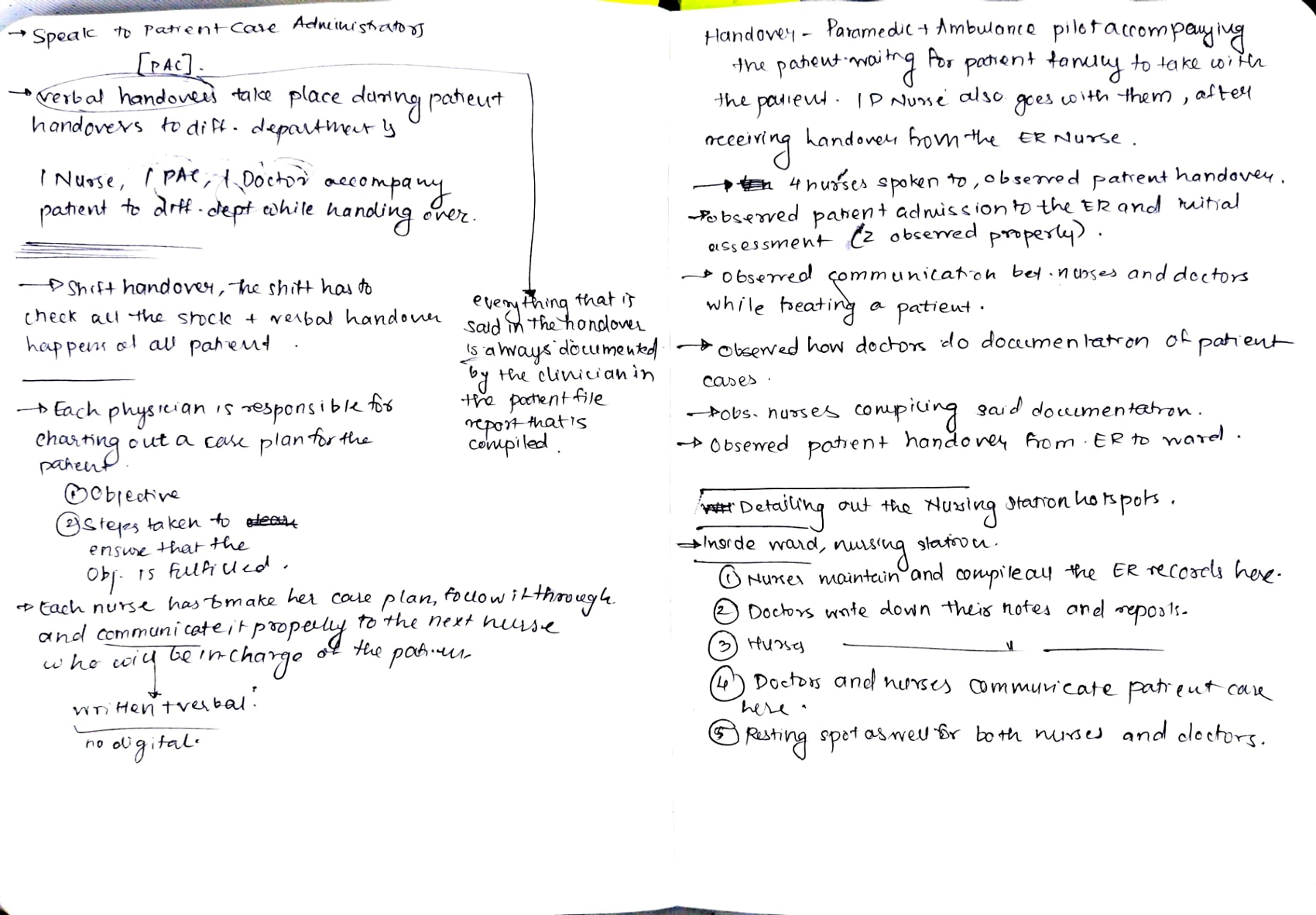
Collaborative Documentation by the Nurses

The nurses have come up with a system to document all the patient cases faster and efficiently. They lay out all the files on a bed and each nurse ends up being responsible for each section of all the files. This makes the job mentally easier for each person. It is an innovation that has come through their value of “In here, everyone is responsible for everything.”

Clinical actions are tied to documentation work

Every clinical action has a paper form attached to it. The documentation system is built around the clinical tasks and procedures specific to SRM hospital and its infrastructure. This also means that the nurses have the responsibility of documenting every action that has occurred using the relevant tool.

Documentation work is an after activity rather than DURING

It is hard for most nurses to document as they go because the medical tasks required to be done are time sensitive and long. This means that while the documentation system is designed in accordance to the clinical actions it doesn’t necessarily work alongside the task.

File is point of reference and not the conversation

Some times if the nurse is too busy to accompany the patient to the IP ward, a paramedic is sent with the patient and carrying the patient file. This means that even though the paramedic might be trained there is a lack of 1 on 1 conversation between the nurses and the file becomes the accurate communicator for the nurse.

Field Notes & Annotations

SRM Hospital

Corporate Hospital, Bengaluru

4 days at Corporate Hospital.


Day 1 & 2 : Emergency Department observational research + interviews


Day 3 & 4: Inpatient Department observational research + interviews with Nurses

Multi specialty Hospital

Medium sized ED

Paperless documentation system

Objective of the visit

Understand how a tech enabled hospital space functions and see potential areas of intervention.

Speak to nurses about the differences in working with paper and digital documentation systems, understand their learning curve and experiences.


Looked at ED to ward handover flow, Patient Admission and treatment, Extensive Documentation processes, ED to ICU handover, IP Nursing Station

Spoken to:

10 nurses

2 doctors

Snippets from interviews

“Sab kuch system mein hai, kisike dimaag mein nahi”

“Sab kuch ka proof hota hai”

What I learnt from field interactions and observations

NETWORK CRASH | Patient Info ? 404 ERROR CODE

The hospital operates on a fully paperless system, especially the ED. The question of a system going down will leave the nurses helpless and armed without any information. Their functions would quite literally stop if the system crashed.

People as Information Systems

.The nurses post handover, get the responsibility of the patient. With the patient comes all of the information that is their previous treatment, history and other things. While all of this is documented and stored in the information systems, more often than not, the nurse becomes the go-to source for getting the information and not the intended system. This leads to the creation of a whole new level in the hospital information architecture.

Synchronous documentation but jugaadu

To reduce documentation time and ensure synchronous work, Nurses work together to find a way around the stress.

For eg: Nurse A is in charge of treating the patient. While she continues treatment, Nurse B takes charge of the documentation to ensure that it happens synchronously and accurately. After the treatment is done, Nurse A adds her Nursing notes in the system. This ensures that documentation is done in time for the handover.

The concept of a System Handover

The nurses use the documented system as a reference point during the handovers. This ensures that the nurses’ cognition is focused on discussing treatment and not on remembering vitals and history that can read off a document while communicating to the IP nurse in a handover. The system handover practice is used during shift handovers as well.

Paper based systems in a paperless world

Informal piece of paper with patient information that the nurses create for their reference. This informal piece of paper is sometimes folded sheets of paper, sometimes dedicated diaries. They are useful to the individual making and using them, but they do not get carried through the responsibility chain. They are temporary holders of information.

Field Notes

The HIS View for the nurses


The nurses input all the treatments administered into the HIS before the handover itself. They also update the Nurses’ notes and Doctor’s notes before starting the handover. The system also contains the patient’s vitals.

The handover happens using the HIS as a guide, with the nurses relying on the information there for the verbal handover(done by following the ISBAR protocol).

Corporate Hospital, Bengaluru

4 days at Corporate Hospital.


Day 1 & 2 : Emergency Department observational research + interviews


Day 3 & 4: Inpatient Department observational research + interviews with Nurses

Multi specialty Hospital

Medium sized ED

Paperless documentation system

Objective of the visit

Understand how a tech enabled hospital space functions and see potential areas of intervention.

Speak to nurses about the differences in working with paper and digital documentation systems, understand their learning curve and experiences.


Looked at ED to ward handover flow, Patient Admission and treatment, Extensive Documentation processes, ED to ICU handover, IP Nursing Station

Spoken to:

10 nurses

2 doctors

Snippets from interviews

“Sab kuch system mein hai, kisike dimaag mein nahi”

“Sab kuch ka proof hota hai”

What I learnt from field interactions and observations

NETWORK CRASH | Patient Info ? 404 ERROR CODE

The hospital operates on a fully paperless system, especially the ED. The question of a system going down will leave the nurses helpless and armed without any information. Their functions would quite literally stop if the system crashed.

People as Information Systems

.The nurses post handover, get the responsibility of the patient. With the patient comes all of the information that is their previous treatment, history and other things. While all of this is documented and stored in the information systems, more often than not, the nurse becomes the go-to source for getting the information and not the intended system. This leads to the creation of a whole new level in the hospital information architecture.

Synchronous documentation but jugaadu

To reduce documentation time and ensure synchronous work, Nurses work together to find a way around the stress.

For eg: Nurse A is in charge of treating the patient. While she continues treatment, Nurse B takes charge of the documentation to ensure that it happens synchronously and accurately. After the treatment is done, Nurse A adds her Nursing notes in the system. This ensures that documentation is done in time for the handover.

The concept of a System Handover

The nurses use the documented system as a reference point during the handovers. This ensures that the nurses’ cognition is focused on discussing treatment and not on remembering vitals and history that can read off a document while communicating to the IP nurse in a handover. The system handover practice is used during shift handovers as well.

Paper based systems in a paperless world

Informal piece of paper with patient information that the nurses create for their reference. This informal piece of paper is sometimes folded sheets of paper, sometimes dedicated diaries. They are useful to the individual making and using them, but they do not get carried through the responsibility chain. They are temporary holders of information.

Field Notes

The HIS View for the nurses


The nurses input all the treatments administered into the HIS before the handover itself. They also update the Nurses’ notes and Doctor’s notes before starting the handover. The system also contains the patient’s vitals.

The handover happens using the HIS as a guide, with the nurses relying on the information there for the verbal handover(done by following the ISBAR protocol).

05 // Grounding Insights

People as Information Systems
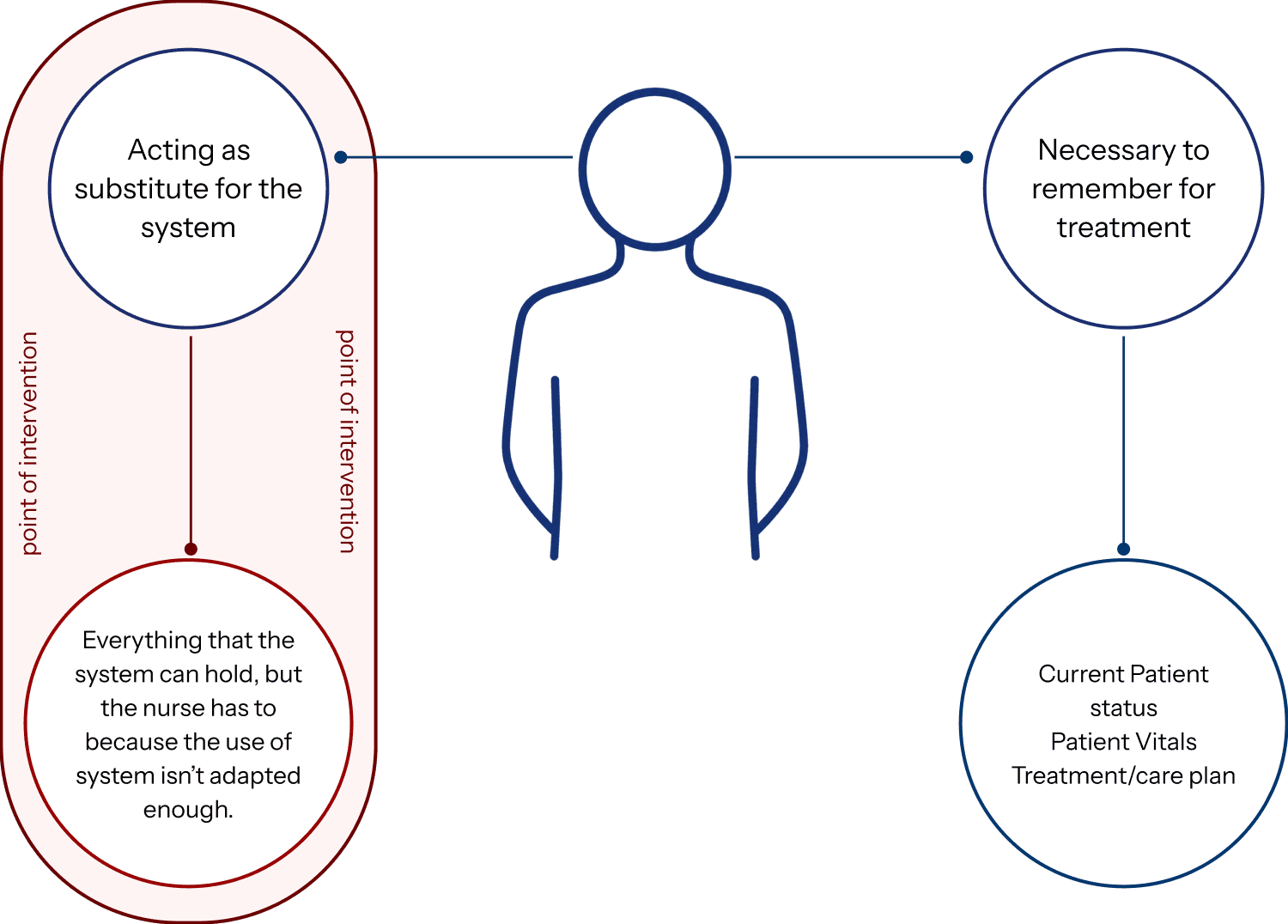
Documentation as a Cognitive Process

a memory reconstruction tool

Helps rebuild what happened, filling gaps and sequencing events

a situational awareness mechanism

Helps make sense of the current state of the patient

a handover rehearsal process

Helps organize, prioritize and communicate what matters to the next caregiver

The solution needed a strong anchor in field insights to avoid drifting into purely technical or practical considerations.

The goal was to ensure AI co-exists with nurses—supporting and optimizing their work without removing them from critical aspects of the clinical process.

The question evolved after field research, becoming more focused to better guide the solution.

How can we relieve cognitive pressures on

ED nurses while retaining the benefits of the documentation process?

06 // The proposed solution

Introducing

“I Manage”

The system that aims to challenge the assumption that clinical documentation should be fully automated. It propose a synchronous, nurse-in-the-loop documentation system that preserves documentation as a cognitive process supporting situational awareness and handover readiness, while reducing mechanical burden through AI-assisted structuring.

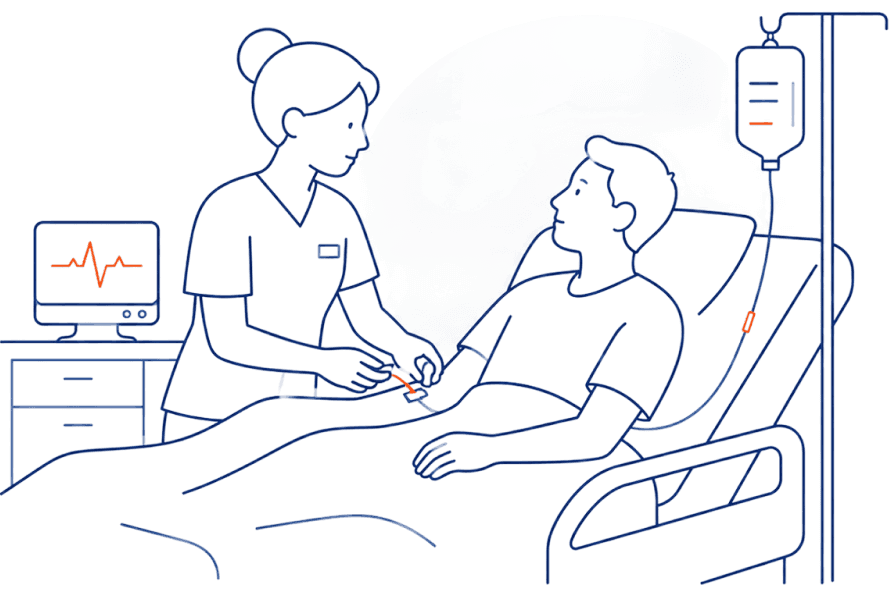
A synchronous, nurse-in-the-loop documentation tool that listens to the clinical conversation as care unfolds, drafts the documentation in real time, and presents it to the nurse for review before handover.
How does the system work?

The Agentic AI system treats documentation as a cognitive process—supporting recall and structure through AI, but preserving human judgment, reflection, and accountability.

Current AI solutions in the market are focused on Ambient AI based transcription, they do not have a strong human in loop element that is specifically designed to reduce workload while retaining the benefits of the activity.

What makes the system different?

07 // Technical Handbook